Eduqas · GCSE · English Language
Respond to spoken language: listening to and responding appropriately to any questions and feedback
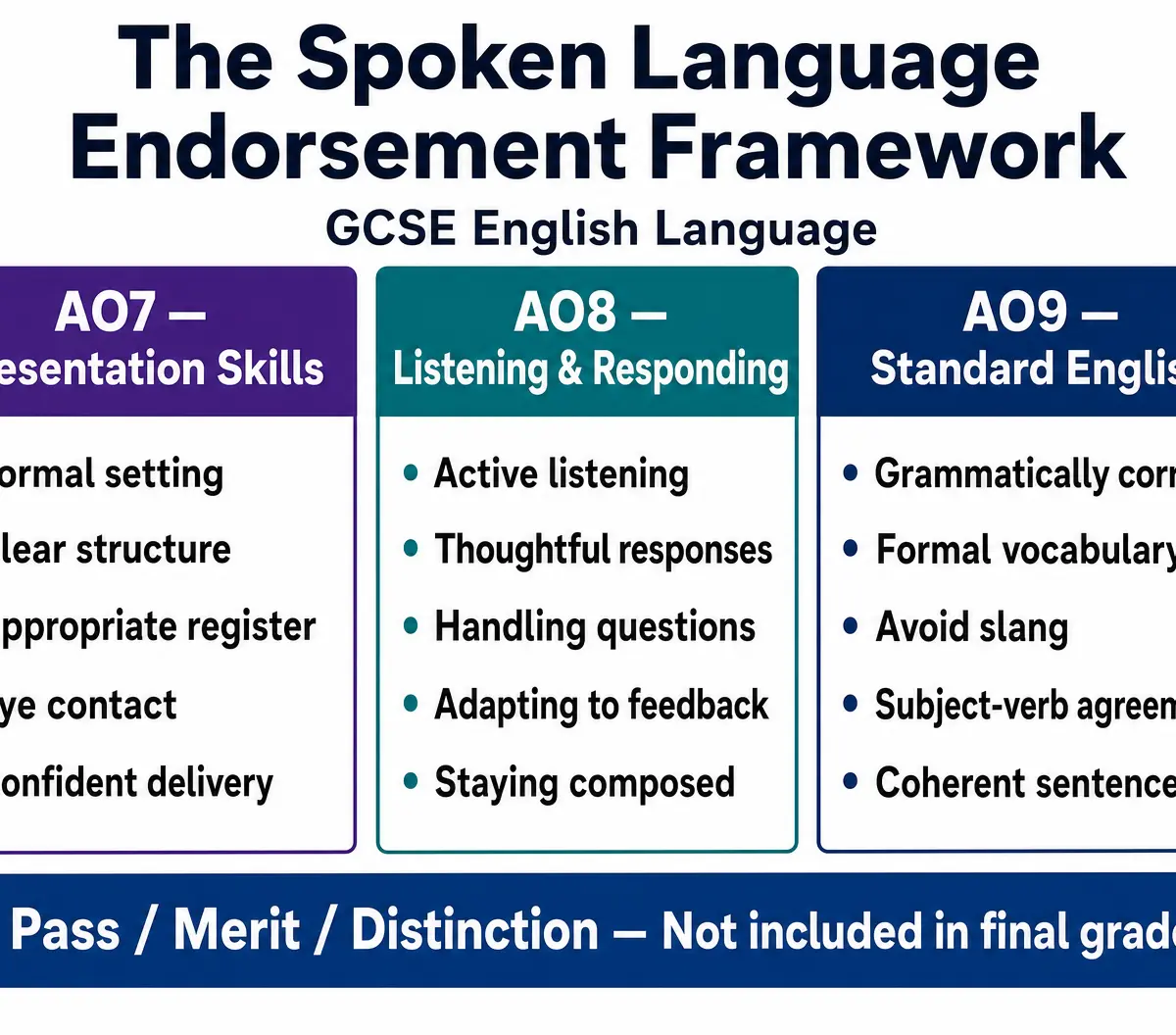
This topic focuses on the Spoken Language Endorsement (AO7, AO8, AO9), which assesses your ability to present information formally, listen and respond appropriately to questions and feedback, and sustain Standard English throughout.
- 4 min read
- 3 worked examples
- 5 practice questions
- 8 key terms
Study Notes
Overview
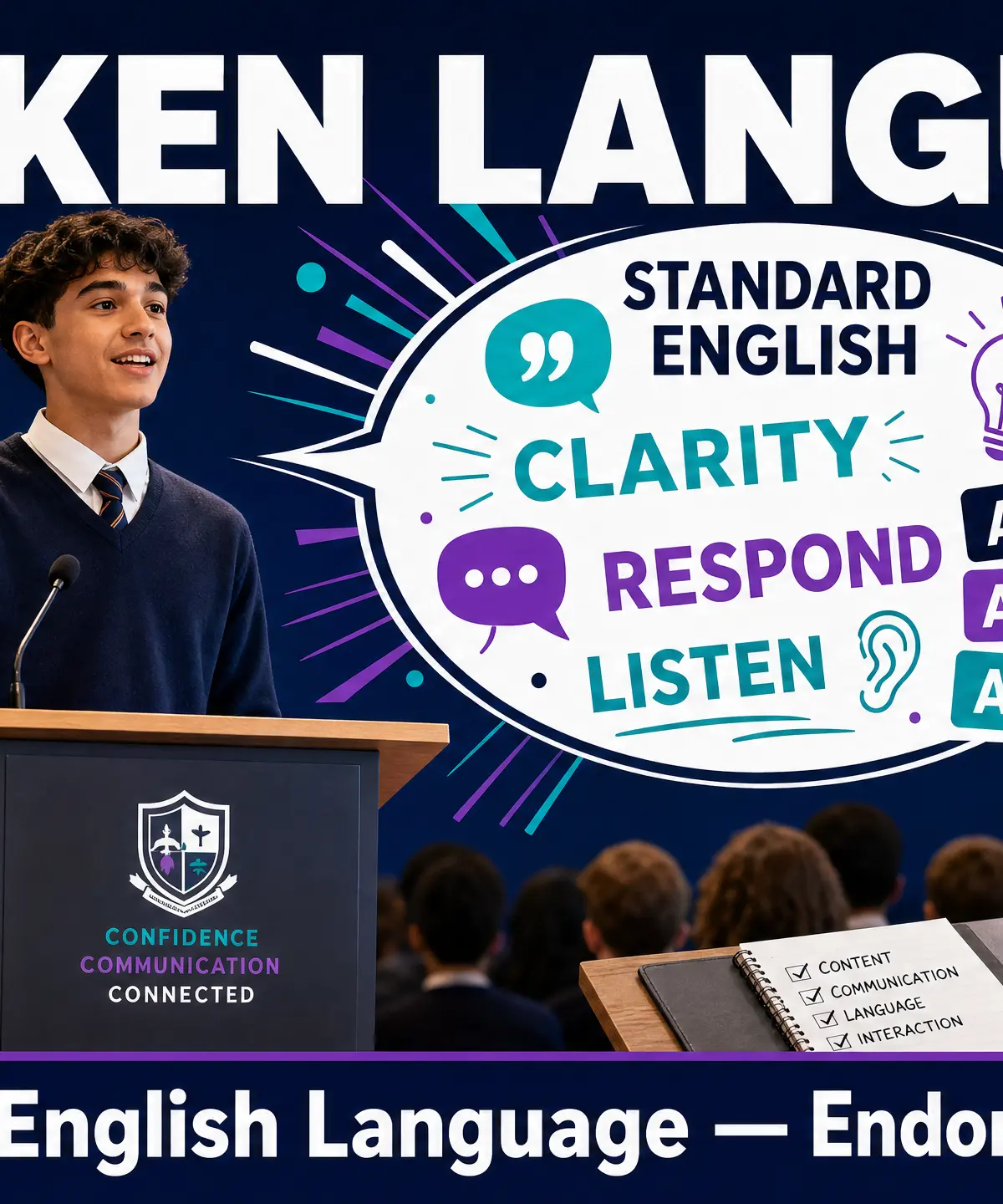
The Spoken Language Endorsement is a mandatory, internally assessed component of the GCSE English Language qualification. While it does not contribute to your final numbered grade (1–9), it is reported separately on your certificate as a Pass, Merit, or Distinction. This endorsement assesses your ability to communicate effectively in a formal setting, demonstrating clarity, purpose, and active engagement with your audience.
There are three Assessment Objectives tested in this component:
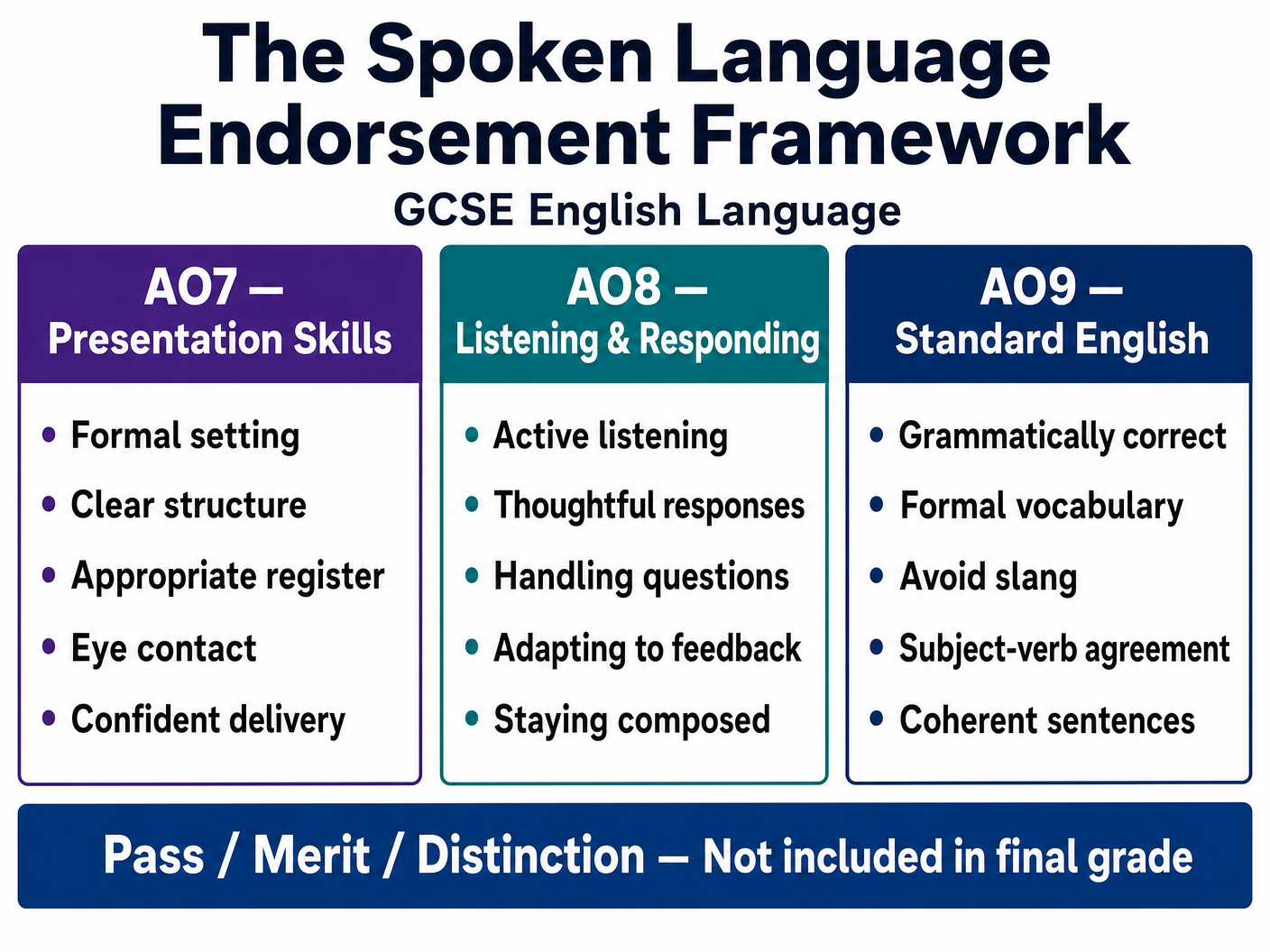
- AO7: Demonstrate presentation skills in a formal setting
- AO8: Listen and respond appropriately to spoken language, including to questions and feedback
- AO9: Use spoken Standard English effectively in speeches and presentations
Preparing Your Presentation (AO7 & AO9)
Choosing a Topic
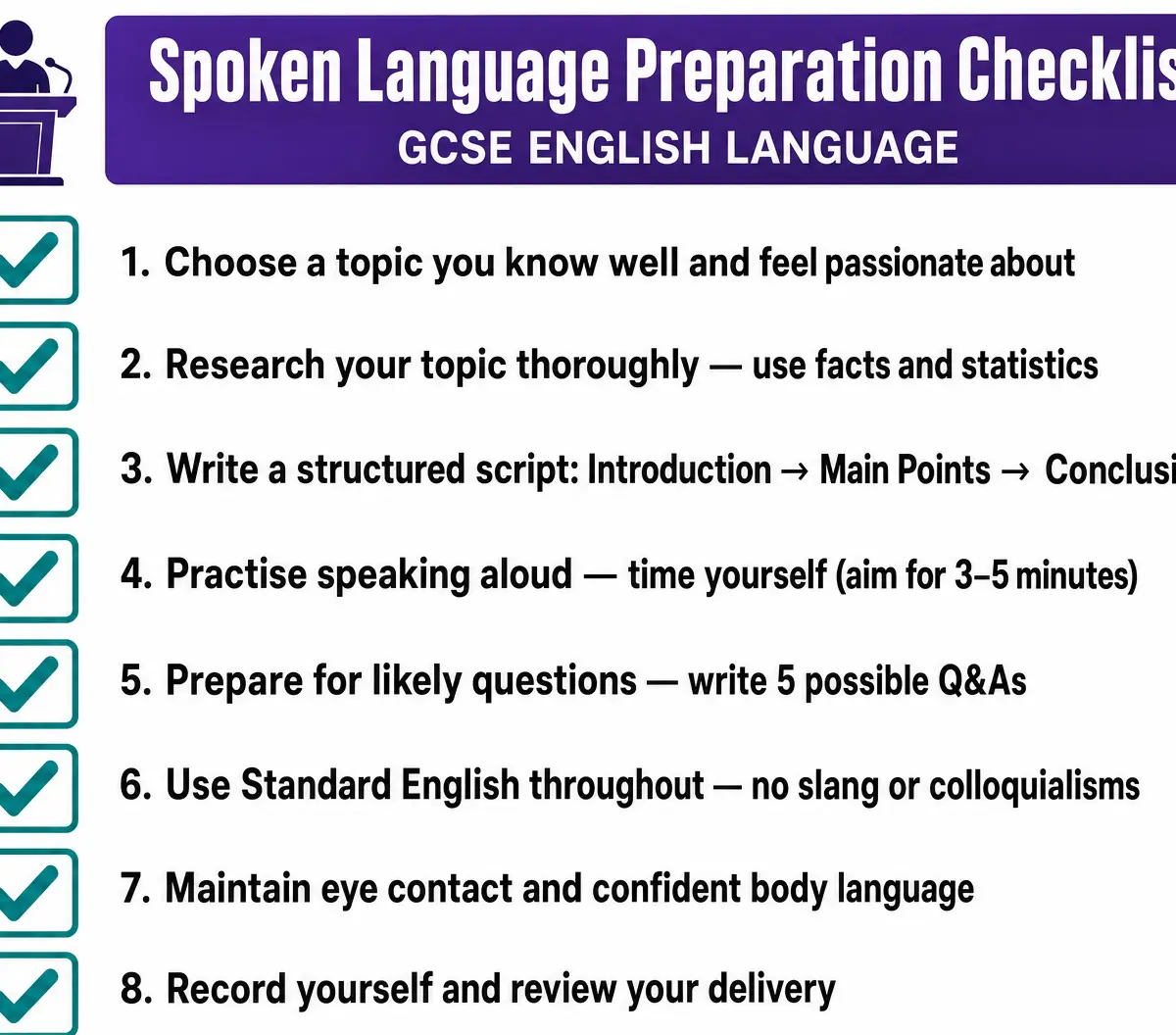
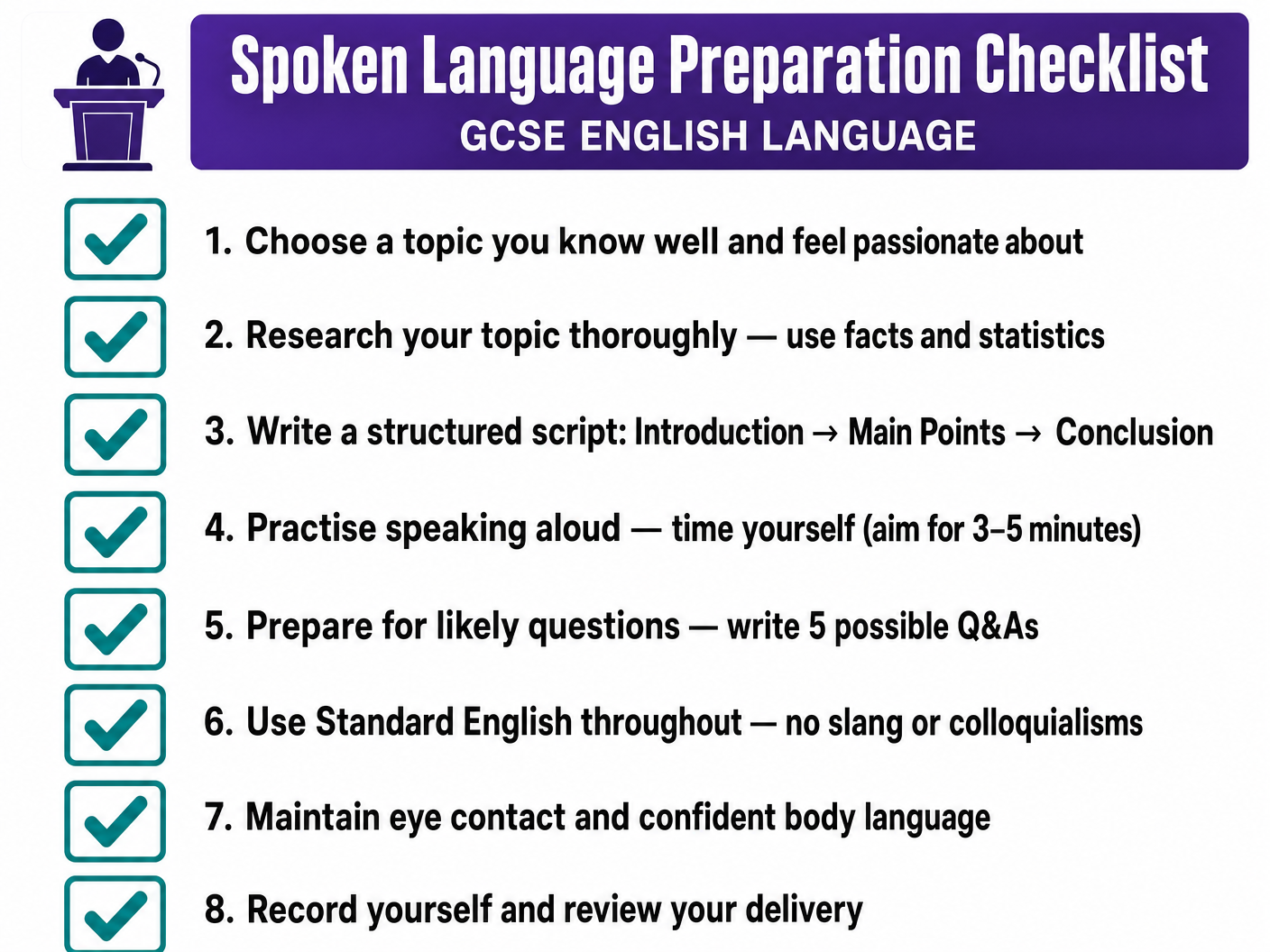
Select a topic you are genuinely passionate about and have researched thoroughly. The more knowledgeable you are, the more confident you will feel. Ensure your topic has enough depth to sustain a 3–5 minute presentation and allows for critical discussion during the Q&A session.
Structuring for Clarity
Your presentation should have a clear, logical structure:
- Introduction: Hook the audience, state your purpose, and outline what you will cover.
- Main Body: Develop 3–4 key points, supported by evidence, examples, or statistics.
- Conclusion: Summarise your main arguments and leave the audience with a memorable final thought.
Sustaining Standard English
Throughout your presentation, you must use formal, grammatically correct English (AO9). Avoid slang, colloquialisms, and filler words (e.g., "like", "you know", "basically"). Ensure subject-verb agreement is accurate and your vocabulary is ambitious and precise.
The Q&A Session: Listening and Responding (AO8)
The question and answer session following your presentation is where AO8 is primarily assessed. This is often where candidates secure—or lose—their Merit or Distinction grades.
Active Listening
When the assessor or a peer asks a question, demonstrate active listening. Maintain eye contact, nod to show understanding, and do not interrupt. Pause briefly before answering to process the question fully; this shows thoughtful consideration.
Formulating Your Response
A strong response should be relevant, developed, and coherent. Use the Point-Evidence-Explain (PEE) or Statement-Development-Link structure even when speaking spontaneously.
- Acknowledge: "That is a very valid point regarding..."
- Answer: Directly address the core of the question.
- Develop: Provide an example, a reason, or refer back to a specific part of your presentation.
Handling Challenges and Feedback
Assessors will deliberately challenge your viewpoint or offer alternative perspectives to test your critical thinking.
- Do not simply agree: If an assessor says, "Some might argue the opposite," do not just say, "Yes, that's true."
- Engage critically: Acknowledge the alternative view, but defend your position logically. For example: "I can understand why that perspective exists, however, the evidence I found suggests..."
Bridging Phrases
Use bridging phrases to buy yourself thinking time without losing your formal register:
- "That is a thought-provoking question; I would say..."
- "I hadn't considered it from that specific angle, but..."
- "Looking at the research, my response would be..."
Podcast Episode: Mastering the Q&A
Listen to our 10-minute podcast episode below, where an expert tutor breaks down exactly how to achieve a Distinction in the listening and responding section of your Spoken Language assessment.
Visual Resources
2 diagrams and illustrations
Interactive Diagrams
2 interactive diagrams to visualise key concepts
Conceptual Flow Outline
Flowchart for handling Q&A responses effectively
Conceptual Flow Outline
The Three Assessment Objectives of Spoken Language
Worked Examples
3 worked examples — open one to explore the question and available guidance.
Practice Questions
Test your understanding — click to reveal model answers
How would you respond if an assessor asked: 'Can you explain why you chose to focus on that specific example rather than a broader overview?'
Hint: Don't just say 'because I found it interesting'. Give a structural or thematic reason.
How would you respond if an assessor challenged you: 'Your argument relies heavily on statistics from one source. Doesn't that make your conclusion biased?'
Hint: Acknowledge the danger of bias, but defend the credibility of your source or mention other supporting evidence.
Identify the error in this candidate's response to a question: 'Yeah, basically I think that the government should like, do more to stop it happening, cos it's well bad.'
Hint: Look at the Assessment Objective for Standard English (AO9).
How would you respond if an assessor asked a question you genuinely do not know the answer to: 'What impact did the 2018 legislation have on this issue?' (Assuming you did not research this).
Hint: Honesty is best, but pivot to something you *do* know.
How would you respond to: 'If you had more time to research, what area would you have looked into next?'
Hint: Show that you understand the breadth of your topic beyond what you presented.